Zum Inhalt springen
unterHUNDs – Hundeschule und Verhaltenstherapie im Saarland Initiative für gewaltfreies Hundetraining

Learning resources

Dog Behavior Workbooks and Learning Tools

Practical help for dog owners, practice for dog trainers. Each built on the research.

What we see in training every week is that owners rarely lack good will. What they lack is a way to tell what is actually going on – and a plan that fits into a normal day. That is what the workbooks are for.

For dog trainers, the step that matters most is a different one: not just recognizing what a dog is showing, but being able to justify how to proceed. That is what the Case Analysis Trainer is for.

For trainers: practice 100 cases and try five evaluations free

For dog owners

Workbooks for everyday behavior problems

Each on one problem, each with worksheets you can print and use. PDF download.

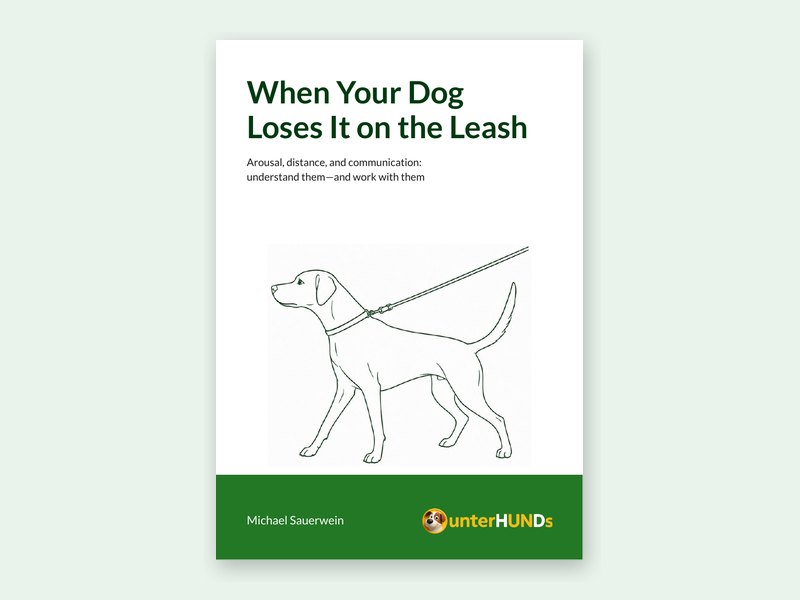
Cover of the workbook When Your Dog Loses It on the Leash

When Your Dog Loses It on the Leash

Arousal, distance, and communication: understand them – and work with them

  • Why your dog can no longer be reached on the leash – and why that is not disobedience
  • The early signals that appear twenty seconds before the barking starts
  • How to find the distance at which training can work at all

€9.90 · 33 pages · PDF · instant download

View the workbook Read a sample

Cover of the workbook When Your Dog Can’t Be Left Alone

When Your Dog Can’t Be Left Alone

Understanding separation anxiety and working on it in small steps

  • A measurement instead of gut feeling: the time until your dog settles, not how long you are gone
  • How to review the recording – and what regularly gets missed
  • Telling three patterns apart, so you don’t spend weeks practicing the wrong thing

€9.90 · 29 pages · PDF · instant download

View the workbook Read a sample

Cover of the workbook When Your Dog Won’t Give It Up

When Your Dog Won’t Give It Up

Understanding resource guarding, avoiding conflict and building the trade

  • For you if your dog suddenly goes still over a chew or eats faster as soon as you walk into the kitchen
  • The signals that come long before the growl – and why even 1,438 owners in one study missed them
  • Two measures instead of gut feeling: what your dog guards, how strongly, and at what distance he stays calm

€9.90 · 33 pages · PDF · instant download

View the workbook Read a sample

Cover of the workbook When Two Dogs Can’t Share

When Two Dogs Can’t Share

Understanding competition in a multi-dog household and bringing calm to everyday life

  • For you if one of your dogs waits to eat until the other one is finished
  • The three patterns a dog uses to secure access – and why two of them go unnoticed
  • Keep a log for a week instead of stepping in: start at the trouble spot with the highest count

€9.90 · 31 pages · PDF · instant download

View the workbook Read a sample

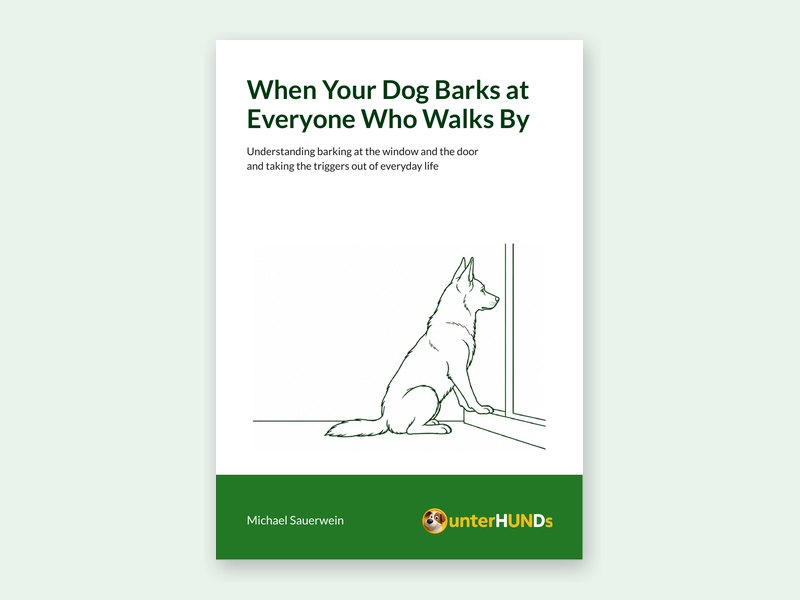
Cover of the workbook When Your Dog Barks at Everyone Who Walks By

When Your Dog Barks at Everyone Who Walks By

Understanding barking at the window and the door and taking the triggers out of everyday life

  • For you if your dog announces everyone who passes the window, the fence or the door
  • Why “stop barking” is the wrong goal – the aim is a short announcement and then quiet again
  • Why it is so persistent: twenty triggers a day against three training sessions a week

€9.90 · 30 pages · PDF · instant download

View the workbook Read a sample

Cover of the workbook When Your Dog Bolts at Every Bang

When Your Dog Bolts at Every Bang

Understanding noise fear, securing everyday life and preparing for New Year’s Eve

  • For you if your dog hides during thunderstorms or New Year’s Eve has been the worst night of his year for a long time
  • Securing and training are two different things – securing starts today, training only outside the season
  • The signs before the trembling: why almost half of owners report signs, but only a quarter call it fear

€9.90 · 29 pages · PDF · instant download

View the workbook Read a sample

How every workbook is built

  • Understanding first. What your dog is doing, why, and why the usual advice often fails.
  • Measuring instead of guessing. Simple logs and scales, so you can see whether something is changing.
  • A plan in small steps. Built for everyday life, not for a training field.
  • Worksheets to print. Logs, plans and checklists you fill in as you go.
  • An honest limit. Every workbook ends with the point at which it is no longer enough – and what to do then.

If you want to go deeper, our research library covers the evidence behind each topic.

What the workbooks do not replace

They do not replace training on site. If your dog shows signs of pain, illness or a sudden change in behavior, see your veterinarian first. If your dog has bitten, has injured himself or another dog, or you are afraid of him, you need someone who can see him in person.

Where a workbook is not the right choice, its page says so before you buy.

For dog trainers

Case Analysis Trainer: 100 practice cases

For dog trainer education, certification preparation and real consulting work. Try five evaluations free.

unterHUNDs Case Analysis Trainer: practice case analysis with 100 cases from everyday consulting, a sample case, scoring on six criteria and professional feedback.

Case Analysis Trainer

For dog trainers in training and in practice

  • 100 cases from everyday behavior consulting, from leash reactivity to aggression toward people
  • Write your own assessment and get feedback on six criteria, with points and concrete guidance
  • A detailed reference solution for every case
  • Practice applying theory to case assessments, as preparation for professional exams and client consultations

5 analyses free · access for 6, 12 or 24 months · one-time payment

Try five evaluations free

For certification preparation and everyday practice

If you are studying to become a dog trainer, case analysis helps you move beyond repeating definitions: you practice forming and justifying a professional assessment. If you already work with clients, the same process can help you reflect on how you weigh explanations, identify risks and plan your next steps.

Naming a behavior is not a case analysis. The professional step lies in weighing the possible explanations, saying what you still need to know, deciding what to prevent right away and judging whether the case is within your scope.

Reading good model answers does not build that skill. Writing your own assessment first and then comparing it with a reference solution does.

The trainer contains 100 prepared practice cases. You write your own assessment, receive an automated evaluation against six criteria and then compare it with a detailed reference solution. It is an online training tool, not a PDF workbook.

What the trainer does not replace is practical experience with real dogs and real owners. It cannot show you how a dog moves, how an owner reacts or how a session unfolds. What it does give you is a feel for the structure of a case: which questions to ask, which explanations to weigh and where your own assessment still has gaps.

Read the guide: Case analysis in dog training

Buying a workbook

  • One-time payment, including the sales tax or VAT of your country. No subscription, no account.
  • You can pay in your local currency by card, Apple Pay, Google Pay or Link.
  • The workbooks are sold through Link, Stripe's checkout service. Link is the seller, sends your receipt and handles payment questions and refunds.
  • Right after payment, you receive your download link by email.

Questions about the content? Write to us at info@hundeschule-unterhunds.de.

Terms of use · Privacy policy · Legal notice